Sunday, November 29, 2015

Water Privatization

We all as humans have certain rights that we all must use and share collectively if we are going to survive as a species on this planet. While some if these things can be debated amongst one another the single most important thing we all need to survive is water. Water should be free for everyone to use and access on this planet for any means necessary. That includes cooking cleaning washing and for drinking. This however is becoming harder and harder in all parts of the world due to the fact that the earths water levels are slowly dropping due to the increased temperature of this planet also known as global warmer and the misuse of the water we have readily available in streams lakes and rivers. Because of these growing problems in the world companies are starting to realize just how powerful and wealthy water is becoming and are trying to buy up as much as they can so they can sell it for inflated prices to the ever demanding populations. This idea of buying up supplies of waters and selling it is known as water privatization.  Some of the most profitable companies in the world such as nestle and coca cola are both buying up trillions of gallons of water packaging it into bottled water and selling it all over the world. This steps into the boundaries of the topic of is water is human right in which nestle CEO stated that he truly does not believe that water is a human right and only certain people with enough power and money should have access to it. His plan is to buy up as much water as he can package it into plastic bottles. This goes against is water a human right because there has been a huge push towards making water accessible for everyone in the world. Especially against those living in third world countries where finding water is hard and people often spend all day trying to find a drink. It is estimated to cost the big companies less than 1 cent to bottle water which they are in turn selling to consumers for over two dollars. That’s over a two hundred percent increase in sales for the companies. Not only does selling water bottles only benefit the companies selling them it have a negative effect on the environment. There are over 500 million water bottle consumed ever year and when those bottle are consumed where do the bottle go? The end up in landfills, dumps, rivers, streams, and eventually the ocean causing countless damage to the ocean and marina life that live in it. A lot of this problem can be resolved if we stop the privatization of the water supply in the world. We all as humans are obligated to have access to free water. No single person no matter how wealthy and powerful they may be should have th ability to control the supply of water on this planet simply because they have the wealth to buy it up. Thousands of people everyday spend most of their time looking for water for their families  so water should be a public right and the idea of it being privatized goes against all human rights.  

https://www.foodandwaterwatch.org/problems/corporate-control-water
http://america.aljazeera.com/opinions/2014/4/water-managementprivatizationworldbankgroupifc.html
https://www.globalpolicy.org/component/content/article/209/43398.html

Sunday, November 15, 2015

Dead Zones

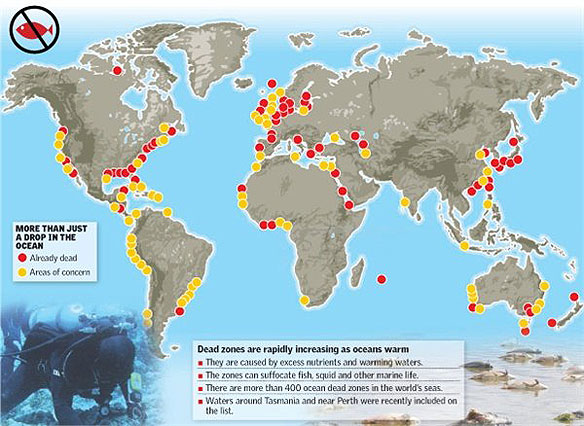
All of life on our planet originated in our oceans. That is what makes our planet so special. We have the ability now days to look at other planets around us and still the only planet we have ever found to have water is our own. Because of this our planet is the only one we have found to have life on it.  It is known that all life began from the ocean. Small cells slowly formed in the ocean and for over million s and millions of years started to evolve and form in fish and the eventually those fish started to move towards land and millions and millions of years later humans evolved. Our oceans are what make this planet so special. There are millions of species that call the ocean home and is the sole center for life on this planet. Because of this you would suspect to find life all throughout the ocean thriving and vibrant. This however is not one hundred percent true. Throughout the ocean there are certain zones in which life is not able to be supported. These areas are known as dead zone and they are completely normal and found throughout the oceans. However, what is starting to alarm scientists is the amount of dead zones the are starting to from in the ocean that were recently undiscovered until recent. Scientist are starting to realize that pollution and climate change are starting to effect the number of dead zones found in the world. These dead zones are areas in the ocean where there if very little oxygen to support life. Due to the low levels of oxygen these areas of the ocean are not able to support life or plants. It is estimated the there are over 200 dead zones alone in the US waters and worldwide the number of dead zones is estimated to be around 500. Dead zones are known as areas of hypoxia or low oxygen areas where little to no life can survive. The puzzling thing about dead zones is that in today’s society these zones are appearing in gulfs of nations where sea life is large and plentiful. Gulf zones are where a lot of the fishing industry gets its products so it unsettling to learn that these zones are forming in areas of the ocean in which we do the most fishing. Also environmental disasters such as the BP oil spill in 2007 and the nuclear disaster in Fukushima Japan due to the tsunami and consequential flooding. If we want to stop these dead zones from forming anymore and make the oceans healthier and full of life and biodiversity we as world need to come together and slowly changes the ways in which we practice our environmental standards. If we continue to have shotty environmental practices in this world these dead zones are not going to go away anytime soon and with that we could start to see the number of species in the ocean start to fall until potentially the oceans are no longer habitable to life of any kind.

http://www.onearth.org/earthwire/devil-deep-blue-sea
http://oceanservice.noaa.gov/facts/deadzone.html
http://www.teachoceanscience.net/teaching_resources/education_modules/dead_zones/learn_about/ 

Sunday, November 8, 2015

Aqua Culture

One of the main things that has really defined us as a human population and has allowed us to really survive and prosper is the way in which we have turned the land that we live on into fields we use to grow hundreds of acres of foods that we eat. Before back in the prehistoric times humans often spent most of the time searching the land for foods to eat and often never had a place to call the permanent home.  We would wander where ever the food was and for most of the time early humans were hunting animals so they often went great distances to find, locate and kill these beasts to provide for their families. However, with the invention of agriculture humans were now able to stay in one place for their entire lives and use the land that they live on to grow foods so they would no longer have to wander everywhere to find their food. As time went on and technology slowly increased humans have always been looking for new way to grow and manage the food population so that we have enough for all our people and have a variety of foods to eat so we do not get bored with eating the same things over and over. This new type of technology that we have created for growing food is known as aquaculture. Aquaculture is the way of using water to farm live fish and other marine animals and plants. Instead of having to go fishing in the large vast ocean we are now able to make tanks or pool in which we are able to grow many species of fish, shellfish and other aquatic types of plants. There are currently two different types of aqua culture that are happening in the United States and other parts of the world, they are marine and freshwater aquaculture. Marine aquaculture refers to the culturing of species that live in the ocean.  U.S. marine aquaculture primarily produces oysters, clams, mussels, shrimp, and salmon as well as lesser amounts of cod, moi, yellowtail, barramundi, seabass, and seabream.  Marine aquaculture can take place in the ocean (that is, in cages, on the seafloor, or suspended in the water column) or in on-land, man made systems such as ponds or tanks.  Recirculating aquaculture systems that reduce, reuse, and recycle water and waste can support some marine species. Freshwater aquaculture produces species that are native to rivers, lakes, and streams.  U.S. freshwater aquaculture is dominated by catfish but also produces trout, tilapia, and bass.  Freshwater aquaculture takes place primarily in ponds and in on-land, man made systems such as recirculating aquaculture systems. Now while both of these type of aquaculture yield different types of food sources is usually comes down to what is available and practical to the one using these systems. Currently the United States is the world leader in the use of aquaculture due to the immense amount of resources and technology while the rest of the world also uses aquaculture the levels in which they use it are not near as large or efficient as the United States
Image result for aquaculture

http://www.nmfs.noaa.gov/aquaculture/what_is_aquaculture.html
http://www.worldwildlife.org/industries/farmed-seafood
http://www.fao.org/fishery/aquaculture/en

Sunday, November 1, 2015

Water Rights

The single most important resource on this planet for our species is water. Water its self is the only reason that we can call this planet home. Without water on this planet life would not be able to happen. Our species came to be from the existence of water.  Millions of years ago when the planet was still very young and had no life on it whatsoever the earth looked very different than it does today. There was no land om the earth. It was covered in nothing but water. From this water we can be the life that is now on this planet. The earliest life forms came from the ocean and slowly made their way to land. My next question is though because water is so important to every human on this planet and essential to human and all life is water a human right? There are two sides to this argument. Some believe that water is not a human right and that you can control who gets water and how much they receive. Water is one of the most valuable resources on his planet because we use it for so many things on a daily basis. Not only is it essential for life but we use it as well for sanitation which is vital to control the spread of diseases to keep the population healthy. People who have access to water are powerful because of just how important water is to living things. However to go against people who do not believe water is a human right are the people who agree that water is indeed a human right and needs to be readily available to every person in the world. in 2010 the UN General Assembly   voted on the this same exact issue and found that yes water is indeed a human right and everyone should have access to it. Not just for drinking and staying hydrated but also in regards to sanitation and keeping waste away from the population. Having the power to restrict access to water from people is huge deal and can potentially lead to hundreds of thousands of deaths. A few thousand years ago huge countries and nations always would have to make sure to build their centers of town near a body of water or access to rivers.  In case of wars with other rival tribes one method of putting the town under siege was to cut access to the town’s water supply and essentially make the city run dry from lack of access to water.  So having access to clean drinking water is one of the most important things in keeping a population healthy. When it comes to my personal opinion on this topic my answer is very simple and straight to the point. I believe that having access to cleaning drinking water is in fact a human right. We are all humans who all need water to survive and live healthy lives. There should not be a certain group of individuals who have the ability to  restrict anyone access to right.

http://www.un.org/waterforlifedecade/human_right_to_water.shtml
http://www.unric.org/en/water/27360-making-water-a-human-right 
http://www.theguardian.com/global-development/poverty-matters/2014/jun/19/un-human-right-water-access-goal