Sunday, November 29, 2015

Water Privatization

We all as humans have certain rights that we all must use and share collectively if we are going to survive as a species on this planet. While some if these things can be debated amongst one another the single most important thing we all need to survive is water. Water should be free for everyone to use and access on this planet for any means necessary. That includes cooking cleaning washing and for drinking. This however is becoming harder and harder in all parts of the world due to the fact that the earths water levels are slowly dropping due to the increased temperature of this planet also known as global warmer and the misuse of the water we have readily available in streams lakes and rivers. Because of these growing problems in the world companies are starting to realize just how powerful and wealthy water is becoming and are trying to buy up as much as they can so they can sell it for inflated prices to the ever demanding populations. This idea of buying up supplies of waters and selling it is known as water privatization.  Some of the most profitable companies in the world such as nestle and coca cola are both buying up trillions of gallons of water packaging it into bottled water and selling it all over the world. This steps into the boundaries of the topic of is water is human right in which nestle CEO stated that he truly does not believe that water is a human right and only certain people with enough power and money should have access to it. His plan is to buy up as much water as he can package it into plastic bottles. This goes against is water a human right because there has been a huge push towards making water accessible for everyone in the world. Especially against those living in third world countries where finding water is hard and people often spend all day trying to find a drink. It is estimated to cost the big companies less than 1 cent to bottle water which they are in turn selling to consumers for over two dollars. That’s over a two hundred percent increase in sales for the companies. Not only does selling water bottles only benefit the companies selling them it have a negative effect on the environment. There are over 500 million water bottle consumed ever year and when those bottle are consumed where do the bottle go? The end up in landfills, dumps, rivers, streams, and eventually the ocean causing countless damage to the ocean and marina life that live in it. A lot of this problem can be resolved if we stop the privatization of the water supply in the world. We all as humans are obligated to have access to free water. No single person no matter how wealthy and powerful they may be should have th ability to control the supply of water on this planet simply because they have the wealth to buy it up. Thousands of people everyday spend most of their time looking for water for their families  so water should be a public right and the idea of it being privatized goes against all human rights.  

https://www.foodandwaterwatch.org/problems/corporate-control-water
http://america.aljazeera.com/opinions/2014/4/water-managementprivatizationworldbankgroupifc.html
https://www.globalpolicy.org/component/content/article/209/43398.html

Sunday, November 15, 2015

Dead Zones

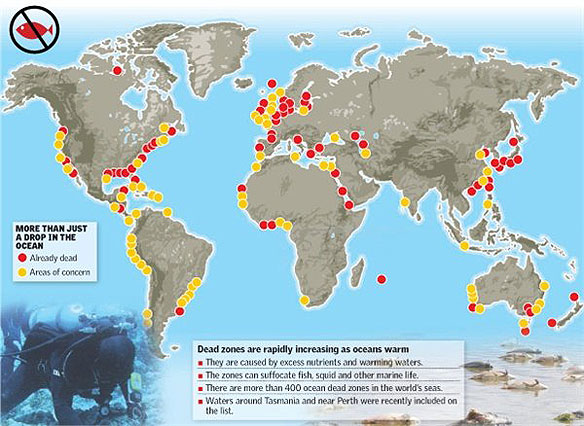
All of life on our planet originated in our oceans. That is what makes our planet so special. We have the ability now days to look at other planets around us and still the only planet we have ever found to have water is our own. Because of this our planet is the only one we have found to have life on it.  It is known that all life began from the ocean. Small cells slowly formed in the ocean and for over million s and millions of years started to evolve and form in fish and the eventually those fish started to move towards land and millions and millions of years later humans evolved. Our oceans are what make this planet so special. There are millions of species that call the ocean home and is the sole center for life on this planet. Because of this you would suspect to find life all throughout the ocean thriving and vibrant. This however is not one hundred percent true. Throughout the ocean there are certain zones in which life is not able to be supported. These areas are known as dead zone and they are completely normal and found throughout the oceans. However, what is starting to alarm scientists is the amount of dead zones the are starting to from in the ocean that were recently undiscovered until recent. Scientist are starting to realize that pollution and climate change are starting to effect the number of dead zones found in the world. These dead zones are areas in the ocean where there if very little oxygen to support life. Due to the low levels of oxygen these areas of the ocean are not able to support life or plants. It is estimated the there are over 200 dead zones alone in the US waters and worldwide the number of dead zones is estimated to be around 500. Dead zones are known as areas of hypoxia or low oxygen areas where little to no life can survive. The puzzling thing about dead zones is that in today’s society these zones are appearing in gulfs of nations where sea life is large and plentiful. Gulf zones are where a lot of the fishing industry gets its products so it unsettling to learn that these zones are forming in areas of the ocean in which we do the most fishing. Also environmental disasters such as the BP oil spill in 2007 and the nuclear disaster in Fukushima Japan due to the tsunami and consequential flooding. If we want to stop these dead zones from forming anymore and make the oceans healthier and full of life and biodiversity we as world need to come together and slowly changes the ways in which we practice our environmental standards. If we continue to have shotty environmental practices in this world these dead zones are not going to go away anytime soon and with that we could start to see the number of species in the ocean start to fall until potentially the oceans are no longer habitable to life of any kind.

http://www.onearth.org/earthwire/devil-deep-blue-sea
http://oceanservice.noaa.gov/facts/deadzone.html
http://www.teachoceanscience.net/teaching_resources/education_modules/dead_zones/learn_about/ 

Sunday, November 8, 2015

Aqua Culture

One of the main things that has really defined us as a human population and has allowed us to really survive and prosper is the way in which we have turned the land that we live on into fields we use to grow hundreds of acres of foods that we eat. Before back in the prehistoric times humans often spent most of the time searching the land for foods to eat and often never had a place to call the permanent home.  We would wander where ever the food was and for most of the time early humans were hunting animals so they often went great distances to find, locate and kill these beasts to provide for their families. However, with the invention of agriculture humans were now able to stay in one place for their entire lives and use the land that they live on to grow foods so they would no longer have to wander everywhere to find their food. As time went on and technology slowly increased humans have always been looking for new way to grow and manage the food population so that we have enough for all our people and have a variety of foods to eat so we do not get bored with eating the same things over and over. This new type of technology that we have created for growing food is known as aquaculture. Aquaculture is the way of using water to farm live fish and other marine animals and plants. Instead of having to go fishing in the large vast ocean we are now able to make tanks or pool in which we are able to grow many species of fish, shellfish and other aquatic types of plants. There are currently two different types of aqua culture that are happening in the United States and other parts of the world, they are marine and freshwater aquaculture. Marine aquaculture refers to the culturing of species that live in the ocean.  U.S. marine aquaculture primarily produces oysters, clams, mussels, shrimp, and salmon as well as lesser amounts of cod, moi, yellowtail, barramundi, seabass, and seabream.  Marine aquaculture can take place in the ocean (that is, in cages, on the seafloor, or suspended in the water column) or in on-land, man made systems such as ponds or tanks.  Recirculating aquaculture systems that reduce, reuse, and recycle water and waste can support some marine species. Freshwater aquaculture produces species that are native to rivers, lakes, and streams.  U.S. freshwater aquaculture is dominated by catfish but also produces trout, tilapia, and bass.  Freshwater aquaculture takes place primarily in ponds and in on-land, man made systems such as recirculating aquaculture systems. Now while both of these type of aquaculture yield different types of food sources is usually comes down to what is available and practical to the one using these systems. Currently the United States is the world leader in the use of aquaculture due to the immense amount of resources and technology while the rest of the world also uses aquaculture the levels in which they use it are not near as large or efficient as the United States
Image result for aquaculture

http://www.nmfs.noaa.gov/aquaculture/what_is_aquaculture.html
http://www.worldwildlife.org/industries/farmed-seafood
http://www.fao.org/fishery/aquaculture/en

Sunday, November 1, 2015

Water Rights

The single most important resource on this planet for our species is water. Water its self is the only reason that we can call this planet home. Without water on this planet life would not be able to happen. Our species came to be from the existence of water.  Millions of years ago when the planet was still very young and had no life on it whatsoever the earth looked very different than it does today. There was no land om the earth. It was covered in nothing but water. From this water we can be the life that is now on this planet. The earliest life forms came from the ocean and slowly made their way to land. My next question is though because water is so important to every human on this planet and essential to human and all life is water a human right? There are two sides to this argument. Some believe that water is not a human right and that you can control who gets water and how much they receive. Water is one of the most valuable resources on his planet because we use it for so many things on a daily basis. Not only is it essential for life but we use it as well for sanitation which is vital to control the spread of diseases to keep the population healthy. People who have access to water are powerful because of just how important water is to living things. However to go against people who do not believe water is a human right are the people who agree that water is indeed a human right and needs to be readily available to every person in the world. in 2010 the UN General Assembly   voted on the this same exact issue and found that yes water is indeed a human right and everyone should have access to it. Not just for drinking and staying hydrated but also in regards to sanitation and keeping waste away from the population. Having the power to restrict access to water from people is huge deal and can potentially lead to hundreds of thousands of deaths. A few thousand years ago huge countries and nations always would have to make sure to build their centers of town near a body of water or access to rivers.  In case of wars with other rival tribes one method of putting the town under siege was to cut access to the town’s water supply and essentially make the city run dry from lack of access to water.  So having access to clean drinking water is one of the most important things in keeping a population healthy. When it comes to my personal opinion on this topic my answer is very simple and straight to the point. I believe that having access to cleaning drinking water is in fact a human right. We are all humans who all need water to survive and live healthy lives. There should not be a certain group of individuals who have the ability to  restrict anyone access to right.

http://www.un.org/waterforlifedecade/human_right_to_water.shtml
http://www.unric.org/en/water/27360-making-water-a-human-right 
http://www.theguardian.com/global-development/poverty-matters/2014/jun/19/un-human-right-water-access-goal

Tuesday, October 27, 2015

The Lichen Study Final Report


                                                    NORTH                                       EAST
                                                  SOUTH                                        WEST
                                                 LOCATION                               BRANCH ID


                                                                   Tree GPS Coordinates  

                                                         39 19'37" N 82 6'0.488" W 
                                                                        
                                                           Quadrant Numbers 
1                                                                  1.)   0-0-1-0 North
2                                                                  2.)   0-1-1-0 South
3                                                                  3.)   0-0-0-1 East
4                                                                  4.)   1-0-0-0 West

                                                                Standard Deviation 
                                                                            .4931


         For the lichen study project I have to admit I was very optimistic. This is because I did not know what lichen was or what its relationship with air quality was.  After we concluded this project however, I am glad that I got to learn the importance of lichens and how they are used as a way to represent the quality of air in their given location. Lichen has a very unique type of symbiosis. Its shares a mutualistic symbiosis between a fungus and cyanobacterium this is a type of symbiosis in which both parties benefit from the relationship.  While lichens have roots that absorb nutrients and water they also have the ability to produce their own food through the process of photosynthesis. Important thing about lichen is their relationship with the quality of air that surrounds them.  Lichens are very sensitive to Sulfur dioxide and nitrogen dioxide pollution in the air. Since industrialization, many lichen species have become extinct in large areas of industrialization. 2 The algal partner seems to be most affected by the Sulfur dioxide; chlorophyll is destroyed and photosynthesis is inhibited. Lichens also absorb Sulfur dioxide dissolved in water. 
       Two of the lichens that we were assigned to investigate specifically for this project are Candellara Sp. Yellow and Physica Sp. Blue/green.  These both are species of lichens that do a remarkable job at identifying air pollution due to they in which they are able to react to pollutants in our air.  Physica Specifically the blue/green colors are very important indicators when detecting heavy metals released from the combustion of automobile engines. While on the other hand Candellera specifically the yellow variety is used as a great indicator of an abundance of nitrogen present in the air surrounding where it lives. this nitrogen is added to the air supply through the exhaust of large factory emissions as well as the exhaust from combustion of fossil fuels in cars and other heavy machinery.
       Beatrix Potter the well-known Victorian-era author of children book such as peter the rabbit is also well known as being one of the first women to understand and study lichens in our history. It is speculated that Mrs. Potter is the first to show the association that lichen is both a fungus and an alga, although many have argued that she is was indeed not the first.  She studied lichens under the microscope, drew their microscopic details and germinated the fungal spores of at least the lichen genus Cladonia. It appears that nobody else in the United Kingdom was doing the sort of advanced microscopic and experimental studies that were being done in continental Europe. It is thought that her fascination with lichens and other fungi’s began because of her love to drawing their unique almost alien like appearance. 
       When it came to selecting a tree for this study I wanted to make sure that the tree that I chose was one where I often walked by on my way to class. This was because if lichen are able to change due to the increased amount of pollution in the air I was curious to see just how high the levels were of some pollutants were in areas I frequently walked through. As for my selection I used a tree I found a Maple tree on College Green just a few hundred feet from Templeton-Blackburn Alumni Memorial Auditorium when walking towards Court Street. This tree stood out to me because it has a high traffic of students walking past it every day and it is situated close to multiple roadways. When it comes to measuring the lichen you should measure the lichen that’s grows at least 1 meter above the ground level. So you may have a better understanding of how air pollutants affect the same air that we all breathe. The area in which I selected my tree was assigned to me. We as a class split campus up into three parts so we could all get our own personal tree and have a better understand of lichens relationship with air pollution across the whole campus as opposed to one specific area. Our group was assigned with all trees from Stewart Street and up, including the College Green.  To complete this study we only needed to use very little equipment. The equipment which I am referring to is 4 wired metal quadrant tool. Each one of the metal quadrants were approximately 10Cm x 10Cm.  Another piece of equipment that we could use but was not required to use was a magnifying glass. This would be used to try and see the smallest pieces of lichen attached to the bark of the tree in every quadrant. The entire goal of this study we have conducted was to get a better understand of what lichen is and where it grows in nature. We also wanted to learn the importance that lichen has in determining the amount of air pollution present in areas which it grows. With this data we have collected I hope that down the line and in years to come we are able to compile this bulk of information on lichens across the campus and use it to determine which areas of campus have the highest levels of nitrogen and sulfur compounds and with these areas of high levels of pollution, what could we do as a whole to help reduce and lower the amount of air pollution in Athens Ohio and more importantly at Ohio University.


http://www.decodedscience.org/little-lichens-more-than-a-plant/20893

Sunday, October 25, 2015

Stream Erosion

Water is the single most important thing to us humans on the planet. Thankfully we can find and locate water on every continent in the world. Water is what makes life on earth possible and without it none of us would be here to experience the gift of life. While water is a pretty common thing to most people many do not understand just how dangerous and powerful water can be. It has the ability to crush things if there is enough of it, destroy whole cities if it takes the form of a tsunami. And even has the ability to carve huge scores into the surface of the earth.  While we don’t really think too much about the power of water we notice it every day in the forms of streams and rivers. Take the Grand Canyon for example one of the natural wonders of the world it was created by thousands of years of erosion due to the Colorado River cutting through its rock to form a beautiful scene. While this erosion is happening there are three things that happen in and under the water that carves the deep channels that we see that rivers form. The three things that I am referring to in relation with stream erosion are solution, suspension and bed load. Solution load refers to the amount of dissolved rocks and other materials floating down stream with the water. These are often over looked due to the fact that they are dissolved into the water from the erosion and often mistake the water as just being water and not really understanding that while yes it is still water there are other things mixed in the water that makes is known as solution load. The next type of load in stream erosion is suspension load. Suspension load is similar to solution load but is made up of slightly bigger rocks and other items that float around in the water. This is similar to solution load but the materials in the water can be seen and separated from the water unlike solution load the materials that float down the river are “suspended” in the water hence the name of suspension load. The third and final type of load in stream erosion is known as bed load. Bed load is the most different from the other types of load. This is because unlike both solution and suspension load, bed load consists of the biggest particles of storm and other debris that usually sits at the bottom of the stream and river and barley move down river. Only when the stream is flowing quickly like after a rainstorm or winter melt off is when the larger materials start to move downstream. Now that you know about three ways in which erosion happens in the streams around the world you now have a better understanding of just how powerful streams and rivers can be and how they are capable of carving the earth hundreds of feet down just like the Colorado River did to form the worlds natural wonder the Grand Canyon.  

http://geography.unt.edu/~williams/geog_3350/examreviews/stream_erosion.htm
http://www.cliffsnotes.com/study-guides/geology/running-water/stream-erosion
http://www.geologyclass.org/Stream%20Concepts.htm

Sunday, October 4, 2015

Urbanization and water

With the steady increase in technology over the years people are starting to learn that living in the rural country is not the easiest way of life anymore and are looking for new, easier places to live in order to help them with some of the many struggles of life. These families of Individuals are looking at the move to bigger more populous cities to help them live easier, safer lives. This trend of moving from rural areas to urban areas is known as urbanization and is happening at rates higher than ever before. Between 2009 and 2050, the world population is expected to increase as much as 2.9 billion people, from 6.8 to over 9 billion people living on this planet. At the same time, urban populations are projected to grow as well with the population. It is estimated that this urban population might increase an additional 3 billion people to over 6 billion people by 2050. With this mass exodus of families into new urban areas these areas are having trouble fitting all the needs of the new population. The most important thing that urban areas are having trouble with is being able to provide enough water for all of their new tenants. The problem with the water is not about a water shortage it is how these major cities are going to be able to provide the water to its resident in a cheap, clean and efficient way.  When these people move into the cities from rural areas they are often put into the slums of the cities.  Slums generally present a set of unique problems, including poor housing conditions, inadequate access to safe water and sanitation, overcrowding and insecure tenure; thus, the welfare of those living in these areas is seriously impacted.  The amount of water that they are provided is critical in keeping the city’s population safe and healthy. While you may think they need water just to drink, think again. More water is used in sewage systems than in any other system in cities and if there is not proper sanitation many horrible things can go wrong to the city’s population. Some of the places in the world where this is becoming a current problem are parts on China and India due to the rapid population growth by both. Both of these countries have well over 1 billion people while the United States is only around 300 million. With the rate of growth in these areas skyrocketing governments are having problems with providing water and sanitation to their respective populations. If the worlds population rates keep rising at the levels they are today the world is going to have serious problem in providing safe and clean water for these people. We’re all going to start to feel the problems associated with the this mass rush of urbanization into populated areas if we all don’t start coming together and devising plans and scenarios to help with the current rate of influx of people into the cities. Water is natural god given right to everyone on this earth if we cannot provide that to them and we really civilized.


http://www.gwp.org/en/ToolBox/CRITICAL-CHALLENGES1/Water-and-Urbanisation/
http://www.unfpa.org/urbanization
http://www.globalchange.umich.edu/globalchange2/current/lectures/urban2/Urbwater.pdf 

Sunday, September 27, 2015

Virtual Water

Water is the single most important thing to our survival as humans on this planet. We all need it to live out our lives. WE westerns take this for granted because we have access to water everywhere we go and don’t ever truly worry about not being able to get a drink when were thirsty or when we need to use some for cooking or other activities. This however is not the case for millions of people across the world. Some places live their entire lives just trying to find enough water to keep themselves and their loved one alive. When we think of water we usually only think of what we use to drink, clean, and cook with as the main uses but were are using water for hundreds of other tasks. This type of water use is known as embedded or virtual water.  This type of water use is refers to the hidden ways in which we use or consume water every day. An example of this is that when growing a field of wheat for process into flour or other cooking uses were use over 1600 cubic meters of water to produce one metric tons of wheat. This number varies on the type of agricultural practices taking place but none the less a huge amount of water usage when you don’t really understand that you are using this much water for something as simple as growing a field of wheat.  The water is said to be virtual because once the wheat is grown, the real water used to grow it is no longer actually contained in the wheat. The concept of virtual water helps us realize how much water is needed to produce different goods and services. Much of the embedded water that we consume, about 70% of our water footprint, comes from other nations, as we import goods and services into our country. Roughly 65% of our water usage comes in the form of food production. The single highest usage of water is in the production of coffee followed by beef. If present levels of consumption continue, two-thirds of the global population will live in areas of water stress by 2025. Increasing human demand for water coupled with the effects of climate change mean that the future of our water supply is not secure. At home it is estimated that we all used 137 liters of water for daily use. Industrial products such as the shirts and pants that we are all wearing use an estimated 167 liters of water per item. With the current drought going on in the western United States and other parts of the world we should all be conscious of how we are all using water. Simple tasks can be adopted and implemented with very little difficulty. Some of these include not eating meat for one day of the week, and when choosing to eat meat select animals who were raised on grass as opposed to grains. Lastly just being more conscious of just how much waste and garbage we are throwing out every day, if we can start lowering all these numbers we could see a huge change in just how much virtually water we consume on a global perspective.


Sunday, September 13, 2015

SOx ans NOx

The air that we breathe every day is vital to living. However this air in which we all rely on is not as clean as it used to be. Every year we are polluting more and more of this air without many regulations on it resulting in devastating consequences. Of this air pollution there are two main chemicals that are causing the most damage; they are Sulfur oxides (SOx) and Nitrogen Oxides (NOx). Sulfur dioxide is being pumped into the air from a few different sources; some are from the burning of fossils fuels at power plants which accounts for roughly 70 percent of the sulfur dioxide emissions and the other being produced from industrial facilities.  The other toxin NOx, is being released into the air that we breathe mostly through the exhaust of cars, trucks, buses and other types of vehicles that travel across the roads. Power plants also contribute to these emissions. With these toxins present in the air they are starting to lead to adverse health effects in people who live near high output sources.  Sulfur dioxide has been known to cause a lot of health problems in certain individuals some of those being increased asthma problems and Broncho-constrictive issues.  The people at risks for these issues are mostly the elderly, children’s and people who have asthma.  Nitrogen dioxide has some of the same health problems that we see with sulfur dioxide.  These issues are airway inflammation, shortness of breath and bronchitis, again effecting the elderly and children more. The reason as to why these toxins are causing problems with breathing is because of how and where in the lungs they are becoming imbedded. These tiny particles and finding their ways into the deepest parts of the lungs and clogging important airways. Once these airways are clogged they cannot be unplugged which is why it is so important to keep the air clean. Along with harming humans these two toxins are causing harm to lichens. Lichens are an alga that grows on trees and are a good way at measuring air quality. Two types of lichens very important to this are Candelavia concolor and physica millegrama. These types of lichens are important due to the fact that they can detect and show when the air quality in a certain area is reaching dangerous levels. They are good at this because they tend to grow on trees in areas where vehicles are abundant. They do not do well in high polluted areas so when researchers go to areas where these lichens should be found and find their numbers low and shrinking they can learn that the amount of pollution in that certain area is reaching dangerous levels and certain measures need to be done to stop the amount of pollution being pumped into the air. Since the beginning of the use of fossil fuels weve have been polluting the air that we breathe to levels that are now starting to harm us in return. Certain measures need to be done to make sure that as we move forward as a planet that we pay more respect to what we are pumping into the air that we breathe.


http://gis.nacse.org/lichenair/?page=airpollution